

Motorcycle Kill Switch for Racing Explained

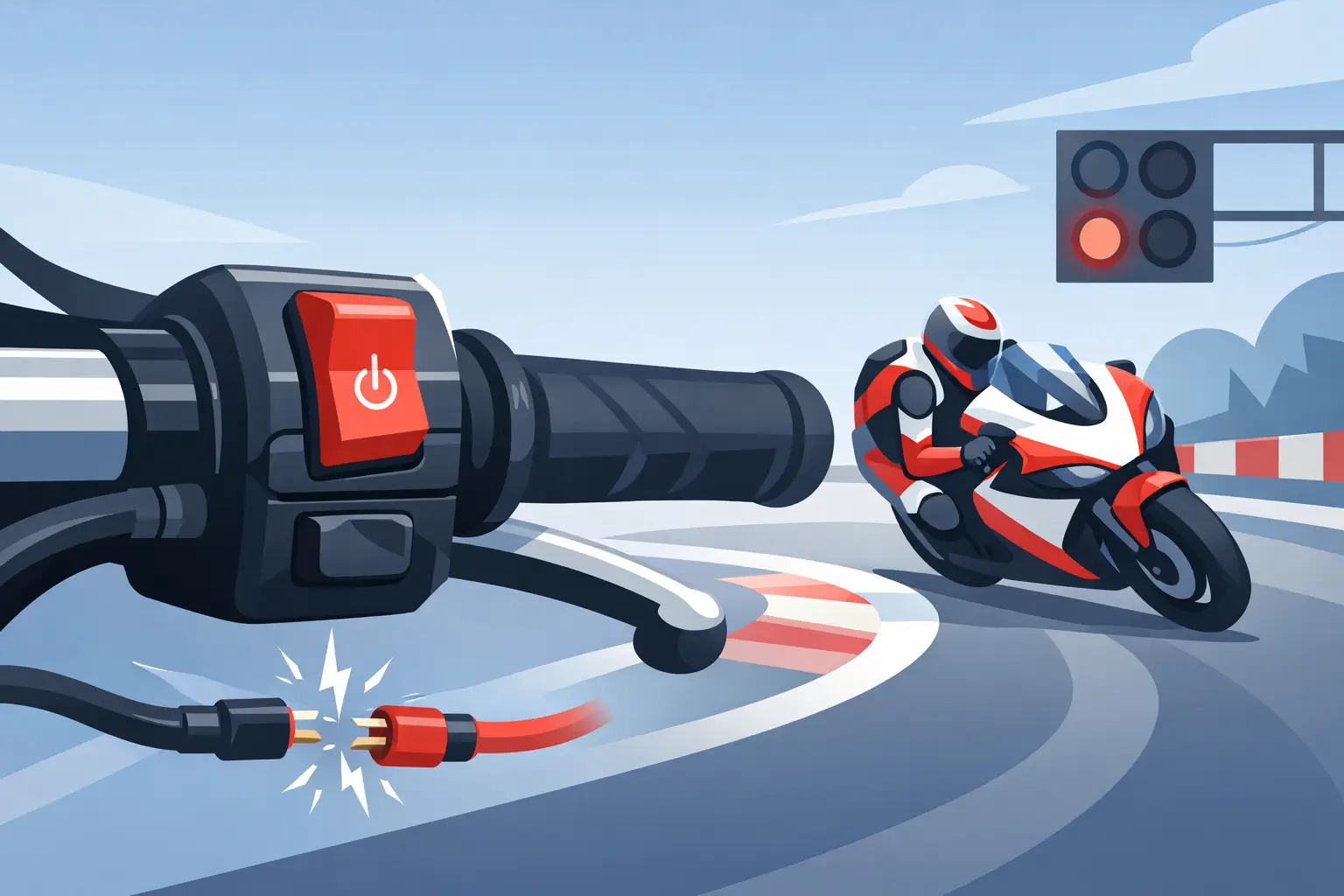
A missed shutoff in the paddock is annoying. A delayed engine stop on the grid, after a tip-over, or during a mechanical issue is a much bigger problem. That is why a motorcycle kill switch for racing is not just another handlebar accessory. It is a control component that needs to work instantly, every time, with gloves on, under stress, and without forcing compromises elsewhere in the cockpit.
For track bikes and race-prepped sport bikes, the kill switch sits in a different category than a street-bike convenience part. On a race build, every control has to earn its space. If the switch is bulky, vague, hard to reach, or poorly integrated with your throttle and bar setup, it becomes a weak point. If it is compact, positive, and properly wired, it supports faster starts, cleaner bar layouts, and safer shutdowns when things go sideways.
What a motorcycle kill switch for racing actually needs to do
At the most basic level, a kill switch interrupts engine operation. That sounds simple, but race use changes the standard. A street switch can get away with extra bulk, softer feel, and a control cluster built around lights, horn, and turn signals. A race switch has a narrower job, and that is exactly the point.
It needs to be easy to locate without looking down. It needs a positive action, so there is no guessing whether the bike is live or off. It also needs to fit cleanly with aftermarket clip-ons, quick-turn throttles, brake master cylinders, and reduced switchgear layouts. On modern sport bikes, packaging matters. Space on the bars disappears quickly once you add race controls.
That is why many racers move to dedicated race switch assemblies instead of adapting OEM parts. The benefit is not just appearance. It is cleaner ergonomics, less clutter, and a more intentional control interface.
Why racers replace the stock switchgear
OEM switchgear is built for broad use, broad regulations, and broad ownership. Racing is none of those things. A race bike is trimmed down to the functions that matter on track, and the kill switch is one of them.
The first reason riders replace stock assemblies is size. Factory left and right switch blocks often take up more room than necessary, especially when you are trying to position brake levers, throttle housings, and clip-ons for your preferred riding position. Compact race switches free up bar space and make fine adjustments easier.
The second reason is feel. A vague or overcomplicated control is the last thing you want when you are strapped into a launch procedure or dealing with an on-track issue. Race-focused switches usually offer a more direct tactile response. That can sound minor until you are wearing thick gloves and trying to react quickly.
The third reason is integration. Many aftermarket race switch units are designed to work with common performance electronics and cockpit layouts. That makes installation cleaner and helps avoid the patched-together look that often comes from mixing OEM street parts with race-only components.
Choosing the right motorcycle kill switch for racing
The right switch depends on the bike, the rest of the cockpit, and how far the build has already moved from stock. There is no universal best option, only the right fit for the application.
Fitment comes first
Before brand, finish, or button style, check compatibility. Handlebar diameter, mounting space, throttle housing design, and model-specific wiring all matter. Some race switches are more universal in mounting but still require bike-specific electrical adaptation. Others are designed around specific makes or models and install more cleanly.
If you are building around Ducati, Yamaha, BMW, Kawasaki, Honda, KTM, Aprilia, Suzuki, Triumph, or MV Agusta platforms, fitment accuracy matters because modern electronics do not always tolerate guesswork. The switch may look simple from the outside, but the bike’s underlying system may not be.
Wiring is where cheap parts get exposed
A switch can feel solid in hand and still be the wrong part if the wiring side is poorly executed. Connector quality, wire routing, insulation, and overall build standard matter on a race bike that sees vibration, heat, repeated bodywork removal, and regular maintenance.
A badly made switch may work in the garage and fail under repeated track use. That is why serious riders tend to stay with respected race brands rather than generic button kits. This is not about paying for a logo. It is about predictable function in a high-stress environment.
Compact is good, but not if usability suffers
Minimalist controls look right on a race build, but there is a limit. If the button is too small, too recessed, or too easy to confuse with another control, the setup has gone too far. You want compact packaging with clear, gloved-hand usability.
That trade-off matters even more if your bike uses multiple bar-mounted race switches for starter, pit lane limiter, launch, map changes, or auxiliary functions. Clean layout is valuable, but clear separation between controls is just as important.
Kill switch layout and rider control
A good race cockpit reduces hesitation. That includes where the kill switch sits and how naturally your hand reaches it.
For most riders, the best position is one that can be activated without changing grip more than necessary. If you have to hunt for the switch, lift your hand excessively, or work around an awkward brake or throttle position, the layout needs attention. This is one of those details that often gets overlooked because the bike still technically works. But a working setup is not always an efficient one.
On sprint bikes, simplicity usually wins. On endurance or more electronics-heavy builds, control density increases, and the kill switch needs to remain distinct within that cluster. This is why cockpit planning matters before buying individual parts one at a time.
Safety, compliance, and race-day reality
A motorcycle kill switch for racing is partly about convenience, but safety is the bigger reason it matters. In a crash, tip-over, fire risk, or mechanical emergency, fast engine shutdown is not optional. Riders, crew, and track staff all benefit when the control is obvious and dependable.
That said, requirements can vary by series, organization, or track-day provider. Some sanctioning bodies have specific expectations around operational controls, while others focus more on general safety readiness. It is worth checking the rulebook before finalizing a cockpit. The right hardware for one class or event may need adjustment for another.
This is also where quality pays off. A switch that sticks, fails internally, or suffers intermittent operation creates a problem you do not need. The part is small. The consequences of failure are not.
When a race switch upgrade makes sense
Not every bike needs an immediate switch replacement. If you are just entering track days and the stock controls still package well with your setup, there may be higher-priority upgrades first. Braking, rearsets, crash protection, bodywork, and suspension setup often move the needle sooner.
But once you start refining the cockpit, adding aftermarket throttles, stripping unnecessary street hardware, or chasing a cleaner race interface, the stock switchgear starts to look out of place fast. That is usually the point where a dedicated race kill switch becomes a practical upgrade rather than a cosmetic one.
It also makes sense if your current setup has damage, inconsistent switch action, or poor bar-space efficiency. Replacing a compromised control with a race-grade unit is not overbuilding. It is basic reliability.
What to look for from a supplier
For a part this specific, product selection matters almost as much as the product itself. You want clear fitment, known manufacturers, and enough detail to understand whether the switch is truly suited to your bike and use case.
That is where a focused race-parts supplier has an advantage over a general accessories store. A catalog built around performance brands, bike fitment, and race-oriented hardware reduces the guesswork. At AXF Race Parts, the value is not only access to premium manufacturers. It is being able to source model-specific race components in one place without sorting through street-oriented filler parts.
For riders and dealers alike, that saves time and lowers the chance of buying a control that looks right online but creates install problems on the bench.
The real value is confidence
A race kill switch is not the flashiest part on the bike. It will not get the attention that brake upgrades, clutch systems, or bodywork do. But it affects every session because it is part of how you interact with the machine.
When the switch is correct, you stop noticing it. That is a good result. It means the control is doing its job with no drama, no extra movement, and no uncertainty. On a race bike, that kind of reliability is not a bonus feature. It is the baseline.
If you are tightening up a track build, look at the controls with the same seriousness you apply to braking, fueling, and chassis setup. The best race parts are not always the loudest ones. Sometimes they are the parts that respond instantly when you need them most.