
Quick Action Throttle Benefits Explained

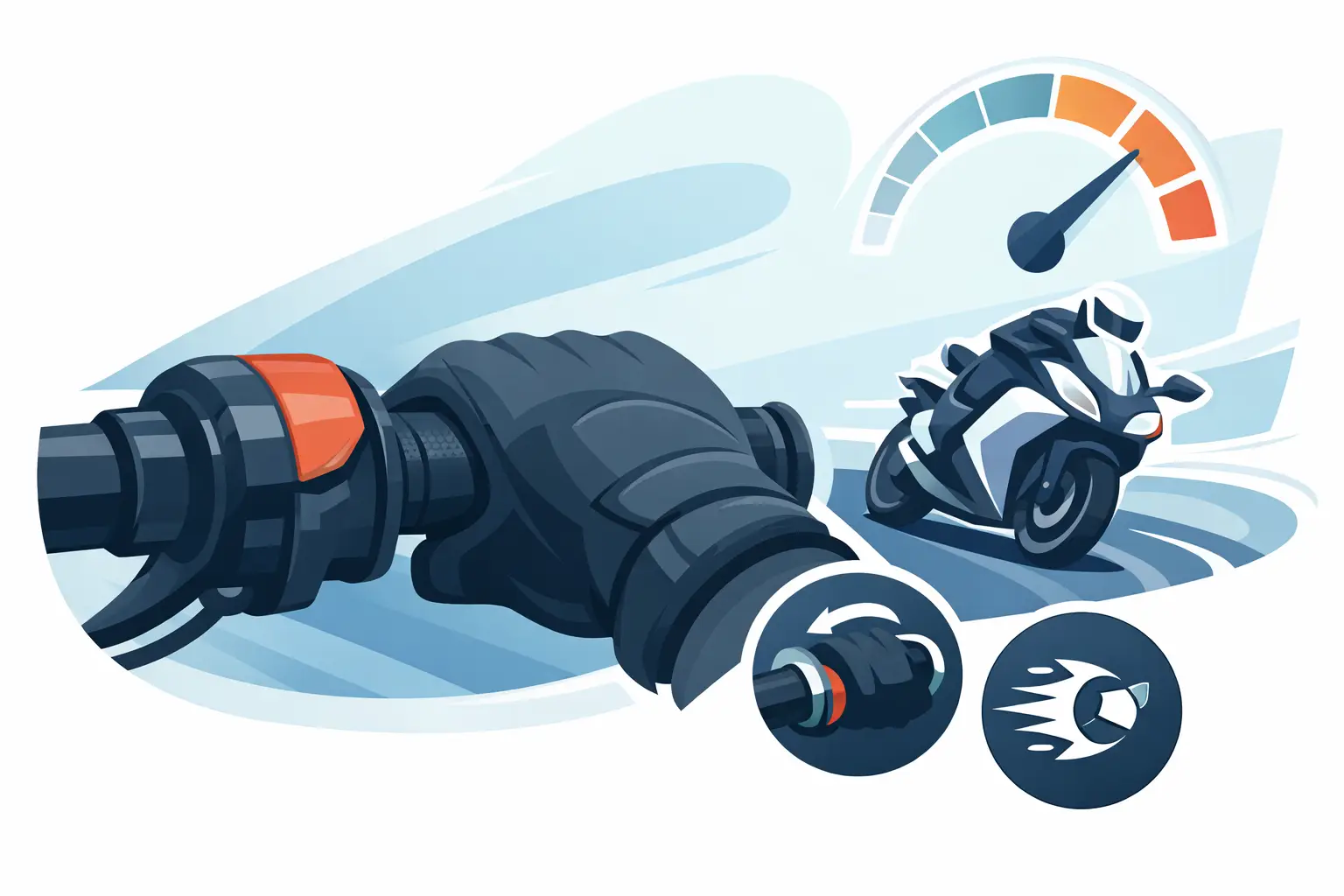
If you have ever found yourself re-gripping the throttle at corner exit, you already understand the appeal behind quick action throttle benefits. On a fast sport bike, small delays in rider input add up. A throttle that reaches full opening with less rotation can make the bike feel sharper, more direct, and easier to manage when pace starts climbing.
That does not mean it is the right upgrade for every rider or every setup. Like most race-focused parts, the value comes from where and how you ride, how refined your throttle control is, and whether the rest of the bike supports the change.
What a quick action throttle actually changes
A quick action throttle reduces the amount of wrist rotation required to open the throttle body or ride-by-wire sensor through its full range. Instead of needing a larger twist to get from closed to wide open, the throttle tube and cam profile shorten that movement.
On the bike, that translates into a more immediate relationship between your hand and engine response. You are not adding horsepower. You are changing how quickly you can access the power that is already there.
For track riders, that matters in two places. The first is corner exit, where getting to your desired throttle position sooner can improve drive. The second is in transitions, where reduced hand movement helps keep your body position settled while you feed power back in.
The real quick action throttle benefits on track
The biggest advantage is speed of input. When the throttle throw is shorter, you can move from maintenance throttle to stronger acceleration with less wrist travel. That sounds minor in the garage. It feels much bigger when you are picking the bike up off the edge of the tire and trying to drive hard without upsetting the chassis.
Another of the core quick action throttle benefits is reduced need to reposition your grip. On many stock throttles, especially on modern 600cc and 1000cc sport bikes, full throttle can require enough rotation that some riders have to adjust their hand mid-application. That is not ideal when you are loaded on the rear tire and trying to stay precise. A shorter throw lets you keep a stronger, more consistent hold on the bar.
There is also a fatigue angle. Less wrist rotation means less exaggerated hand movement over a session. That does not magically fix arm pump or bad ergonomics, but it can reduce one small layer of physical effort, especially on bikes that spend a lot of time accelerating hard between slower corners.
The final benefit is consistency. A good quick action throttle assembly often provides a cleaner, more mechanical feel than a tired stock tube and housing. With quality machining, smoother operation, and proper cable setup, rider inputs can feel more repeatable. For a club racer or serious track-day rider, repeatability is where lap time starts to become more predictable.
Why some riders feel faster right away
A quick action throttle can make a bike feel more aggressive even before lap times change. That sharper response often gives riders more confidence because the motorcycle reacts with less delay between intention and output.
On corner exit, that confidence can help you commit earlier. On straights, it can help you get to full drive without the awkward extra twist that comes with some OEM throttle assemblies. Riders coming from race bikes or heavily prepared track bikes usually notice this immediately because they are used to direct controls everywhere else on the machine.
It is the same reason racers upgrade rearsets, levers, and switchgear. The control interface matters. If the contact points feel vague or slow, the bike feels less precise than it actually is.
Where quick action throttle benefits are most noticeable
The upgrade tends to make the biggest difference on high-performance sport bikes ridden aggressively. A 600cc supersport ridden on tight technical tracks can benefit because the rider is constantly working between partial and heavy throttle. A liter bike can benefit because getting to the desired opening faster helps manage the bike’s acceleration phase with less hand movement.
It is also especially useful for riders with limited wrist mobility or larger hands who dislike stock throttle throw. What feels acceptable on the street at moderate pace can feel too long once speed increases and body position becomes more committed.
Bikes with aftermarket electronics, race bodywork, and a more dedicated cockpit often benefit more simply because the rider is already chasing sharper control feel across the whole package. In that context, a quick action throttle is not an isolated mod. It is part of a race-ready control setup.
The trade-offs you should know before buying
This is not a universal upgrade with zero downside. A shorter throw makes the bike more sensitive to hand input. If your throttle control is abrupt, the result can be a bike that feels twitchier than before, especially in low-speed sections or on imperfect pavement.
That matters even more on high-torque twins, powerful inline-fours, or bikes with aggressive fueling maps. If the engine already responds sharply off closed throttle, a quick action setup can amplify that feeling. Some riders love it. Others install one and realize they preferred the forgiveness of the stock throttle.
There is also a setup factor. A poorly installed throttle, incorrect cable adjustment, or mismatched cam profile can create friction, excessive free play, or inconsistent return. The part itself may be high quality, but if the installation is not right, the benefit disappears fast.
Street riders should also be honest about use case. If the bike spends most of its life commuting, cruising, or running in traffic, the performance gain may not justify the sharper feel. The more your riding leans toward track use, canyon pace, or competitive riding, the stronger the case becomes.
Choosing the right quick action throttle
Not all quick action throttles feel the same. The main variables are throttle ratio, cam design, cable compatibility, housing quality, and bike-specific fitment. Some systems offer interchangeable cams so you can tune how aggressive the throttle response feels. That flexibility is useful because the ideal setup depends on the engine character and rider preference.
Material quality matters too. A well-made throttle assembly should feel solid, smooth, and precise, not notchy or cheap. This is a control part, not a cosmetic add-on. Poor tolerances show up immediately in the way the bike responds.
Fitment is where many buyers lose time. The right throttle needs to match the bike’s cable arrangement or electronic system and work cleanly with your bar setup, controls, and fairing clearance. That is why fitment-driven sourcing matters. On a catalog built for race bikes and performance applications, like https://shop.axfraceparts.com, it is much easier to narrow the right option by bike, model, and year instead of guessing from generic listings.
Installation and setup matter more than most riders expect
A quick action throttle should snap back cleanly and operate without drag through the full steering range. Cable routing, free play adjustment, and housing alignment all affect that result. If the bars are turned and the idle changes, something is wrong. If the throttle return feels slow, something is wrong.
This is also not the place to ignore the rest of the cockpit. Worn grips, bent bars, cheap switchgear, or badly positioned brake levers can all interfere with how usable the upgrade feels. The best results come when the throttle is part of a control package that has been set up intentionally.
For race bikes, pair the upgrade with proper lever position, stable clip-ons, and a throttle map that is actually suited to the engine build. For street-performance bikes, make sure the fueling is sorted before assuming the throttle tube alone will fix abrupt response.
Is it worth it for your bike?
If your current throttle feels too long, forces you to re-grip at full drive, or dulls the connection between hand and engine, the answer is often yes. The performance gain is not theoretical. It shows up in how quickly and confidently you can apply power.
If you are still developing smooth throttle habits, the answer is maybe. A quick action throttle can sharpen the bike, but it can also expose sloppy inputs. Some riders improve with that feedback. Others go quicker by keeping a more forgiving setup until their control catches up.
That is the real value of this upgrade. It is not about making the bike more dramatic. It is about making rider input more efficient. When the fitment is right, the quality is there, and the rider knows what they want from the front end and corner exit, a quick action throttle is one of those parts that earns its place every lap.
Choose it because you want faster access to power and cleaner control, not because it sounds race-spec. The best parts on a performance bike are the ones you can feel working every time you pick the bike up and drive.

 Canada
 USA
USA Japan
Japan