
Sprint Filter vs Stock Air Filter

If you are already spending money on brakes, rearsets, electronics, and race bodywork, leaving the intake side untouched deserves a second look. The air filter is not a glamour part, but it directly affects airflow, throttle response, service intervals, and how consistently your bike performs when the pace picks up.
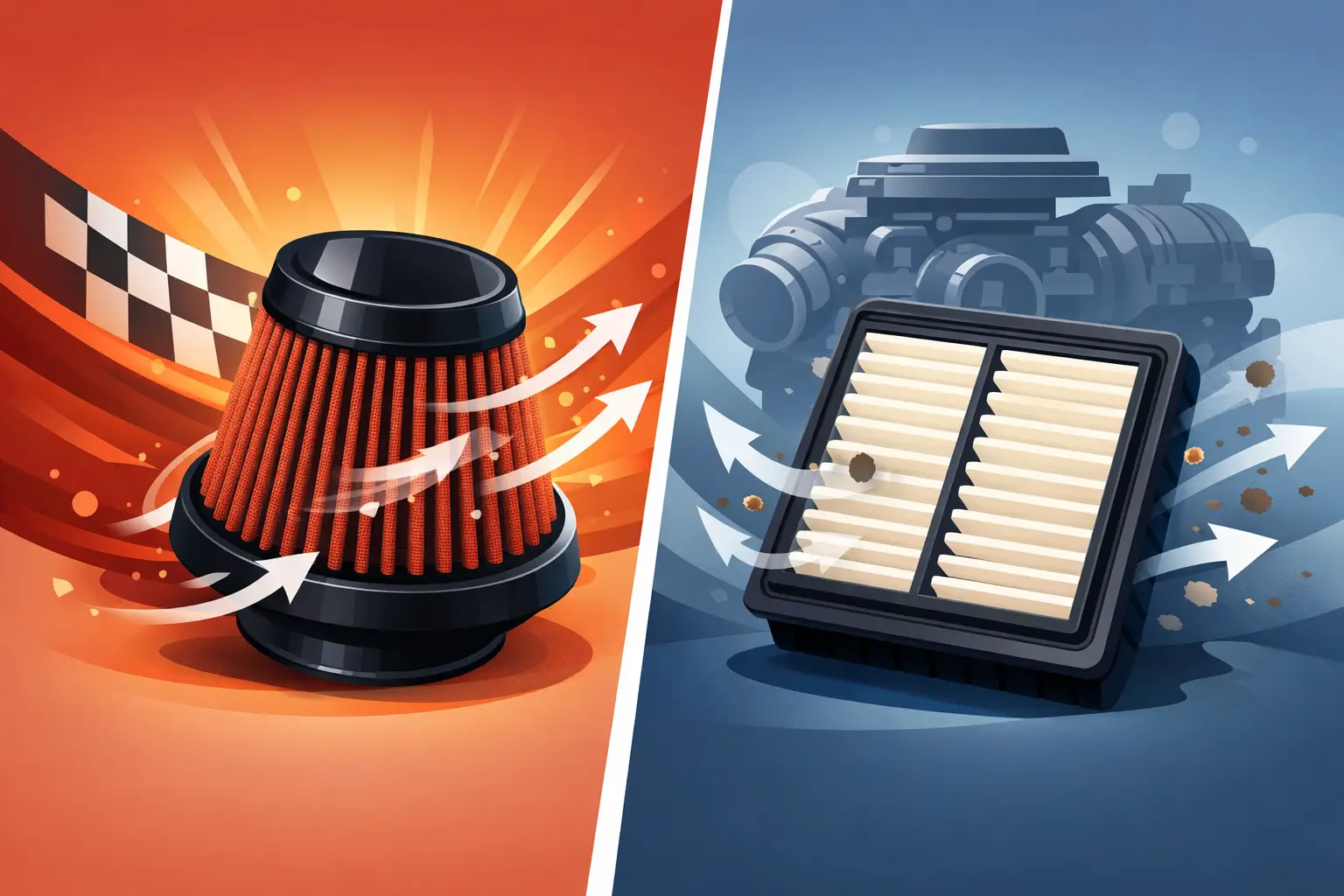
That is why the sprint filter vs stock air filter question comes up so often with sport bikes and race-prepped motorcycles. On paper, both filters do the same job. In practice, they are built around different priorities. A stock filter is designed for broad OEM requirements like cost control, noise management, emissions compliance, and long-term street use across a wide range of riders. A Sprint Filter is built with performance as the priority, with filtration technology aimed at high airflow, repeatability, and serviceability.
For riders who care about lap times, clean fueling, and dependable performance parts, the difference matters.
Sprint filter vs stock air filter: what really changes?
The biggest difference is not just that one is aftermarket and one is OEM. It is how each filter handles airflow and maintenance over time.
A stock air filter on most modern sport bikes is typically a paper-style element. It is effective, inexpensive to manufacture, and works well for standard use. For a street rider who follows regular service intervals and keeps the bike close to factory spec, a stock filter is usually a safe and predictable choice.
A Sprint Filter uses a polyester-based filtering material rather than conventional paper media. That construction is a major reason performance riders look at them in the first place. The material is designed to maintain strong airflow while still providing controlled filtration, and it can be cleaned and reused instead of simply thrown away at each replacement interval.
That does not automatically mean every bike will gain a dramatic horsepower number from the filter alone. Real gains depend on the motorcycle, the tune, the intake and exhaust setup, and how restrictive the OEM filter was to begin with. What usually stands out first is improved breathing at higher rpm and a sharper response when the engine is working hard.
Airflow and performance on sport bikes
If your bike spends most of its life commuting, the stock filter may never feel like a serious limitation. If it sees hard canyon use, track days, or club racing, the conversation changes.
At high load and high rpm, an engine needs a stable supply of air. Any restriction in the intake system can affect how willingly the engine revs and how cleanly it carries power through the upper range. This is where a Sprint Filter tends to make more sense. It is designed for higher flow efficiency, which can support better engine response in conditions where performance matters most.
On a modern superbike or supersport, the filter is only one piece of the package. If the bike also has a performance exhaust, velocity stacks, ECU flash, or race mapping, a high-flow filter becomes more relevant because the rest of the system is already moving away from factory compromise. In that context, sticking with a restrictive stock-style paper filter can become the bottleneck.
That said, riders should keep expectations realistic. A filter is not a magic part. It is a supporting performance upgrade. The real value is often in how it complements a properly sorted setup rather than acting as a standalone transformation.
Filtration quality is not a side issue
Performance riders are right to focus on airflow, but filtration still matters. More airflow means very little if dirt control is poor and the intake tract pays the price.
This is where the comparison needs nuance. Some riders assume a performance filter must be trading away filtration for flow. With quality products, that is too simplistic. Sprint Filter built its reputation around specialized filter media that targets both airflow and controlled particle capture. The exact specification can vary by filter type and intended use, but the core point is that these are engineered products, not generic high-flow elements.
A stock filter also does its job well in normal conditions, especially for street mileage and varied weather. OEMs build around reliability and wide operating conditions, so the baseline standard is solid. If your bike is mostly stock, ridden conservatively, and maintained on schedule, there is nothing inherently wrong with staying OEM.
The choice comes down to use case. For aggressive riding and performance builds, a properly matched Sprint Filter offers a more performance-oriented balance. For general transportation with minimal interest in tuning or reusability, a stock filter remains functional and straightforward.
Maintenance and long-term value
This is one of the clearest areas where the two options separate.
A stock paper filter is usually disposable. Once it is dirty or reaches the service interval, it gets replaced. That is simple, but over time it adds recurring cost. For riders who log a lot of miles, attend frequent track days, or maintain multiple bikes, those replacements stack up.
A Sprint Filter is reusable. That changes the ownership equation. Instead of buying a new filter each time, you clean the existing unit and put it back in service. For performance riders and race teams, that is more than a convenience. It means predictable maintenance, less downtime waiting on replacement parts, and better long-term value from a premium component.
There is also a consistency advantage. If you know your bike setup works with a specific reusable filter, cleaning and reinstalling the same part can help maintain a known baseline. That matters when you are trying to keep a race bike or track bike repeatable between events.
Tuning implications
Any serious sprint filter vs stock air filter discussion should include fueling.
On some motorcycles, you can install a Sprint Filter and ride away without any immediate issue. The bike will run, and the ECU may adapt within limits. On others, especially bikes with exhaust changes or existing tuning work, the increased airflow can shift fueling enough that a tune or flash becomes the smart move.
If your goal is maximum performance, assume the filter should be treated as part of the intake package, not as an isolated bolt-on. The right approach is to consider the entire system – intake, exhaust, fueling, and ECU strategy. That is how you turn a parts change into a measurable result.
For a stock street bike, the change may be modest without additional tuning. For a modified track machine, the filter can be one more step toward freeing up the top end and sharpening delivery where you actually use it.
Which riders should stay stock?
There are still cases where a stock air filter is the right answer.
If the bike is under warranty, used mainly for commuting, and you are not chasing performance gains, OEM simplicity has value. If you prefer replacing parts rather than cleaning and servicing them, a disposable stock filter also fits that mindset better. And if the bike is completely stock with no plans for mapping, exhaust, or intake changes, the practical benefit of a performance filter may not justify the switch for every owner.
That is not a knock on Sprint Filter. It is just matching the product to the rider.
Who benefits most from a Sprint Filter?
Track-day riders, club racers, performance street riders, and tuners are the obvious fit. If your bike is already seeing supporting upgrades, a high-flow reusable filter makes more technical and financial sense.
It is especially relevant for riders who want every component to support the same objective. There is no point fitting premium braking components, dialing in suspension, and refining electronics while leaving a basic disposable filter as a weak link in the intake system.
For shops and dealers, reusable fitment-specific intake upgrades also make sense because customers are looking for race-proven parts that solve a real performance problem, not cosmetic add-ons. That is exactly why specialist suppliers such as AXF Race Parts focus on brands with proven credibility in the sport bike and racing space.
The real decision: convenience or performance bias
The best way to frame this is simple. A stock filter is built around broad OEM compromise. A Sprint Filter is built around performance bias.
Neither is universally right for every rider. If your priorities are low upfront cost, stock replacement convenience, and factory-normal operation, the stock filter still does the job. If your priorities are airflow, reusable service life, and supporting a faster, more responsive setup, Sprint Filter is usually the stronger choice.
For most performance-focused sport bike owners, that is the answer. Once the bike moves beyond basic transportation, the stock paper filter starts to look like a maintenance item. A Sprint Filter starts to look like a component.
Choose the part that matches how the bike is actually used. If the machine is built to perform, the intake should be held to the same standard.

 Canada
 USA
USA Japan
Japan