

Racing Battery Selection for Track Motorcycles

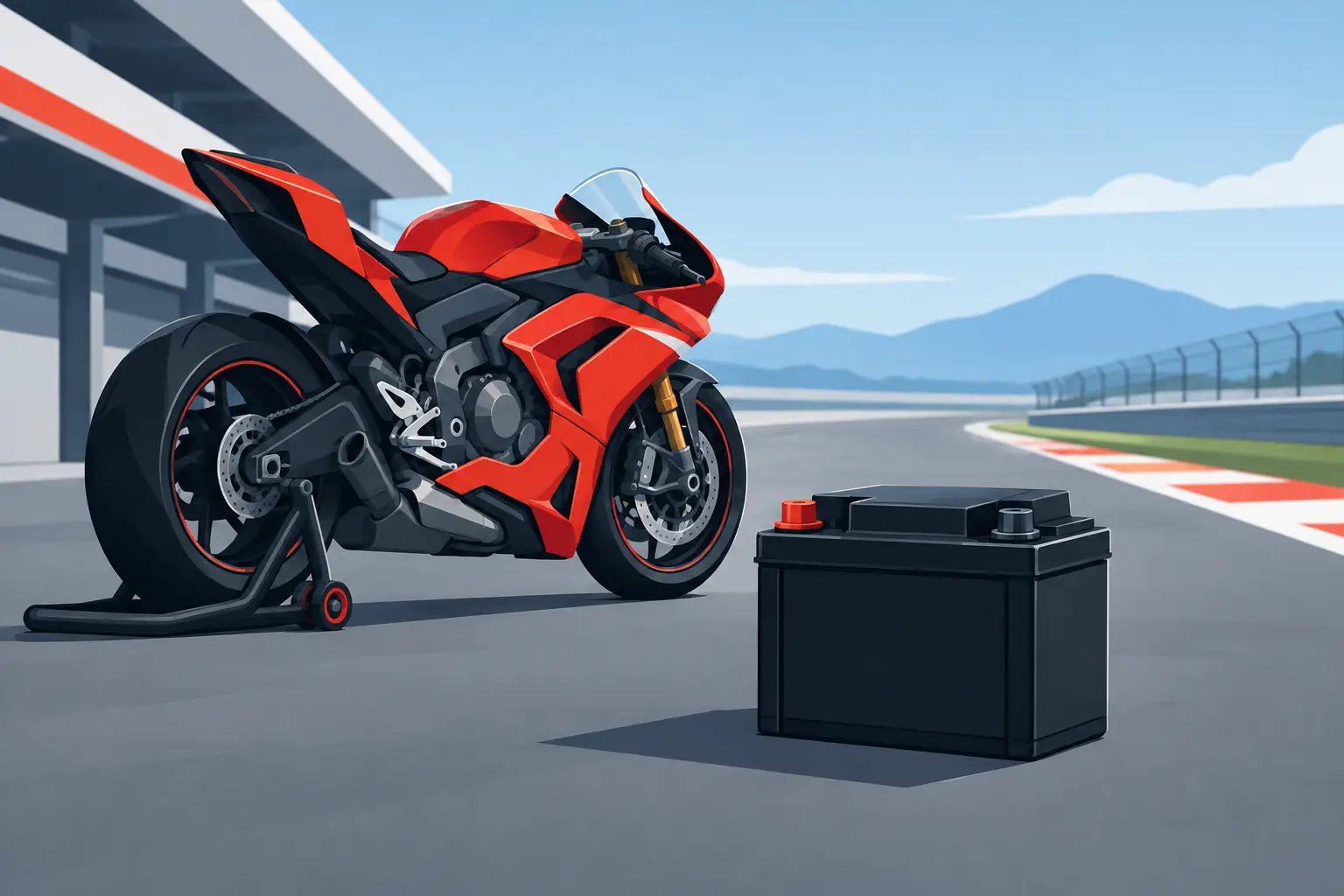
A battery failure can end a race weekend before the warmers come off. The right unit has to crank a high-compression engine, support modern electronics, fit the battery box correctly, and tolerate the vibration and heat of track use. Racing battery selection is not simply a weight-saving exercise. It is a fitment, electrical-system, and reliability decision.
For a race-prepared sport bike, the lightest battery is only the right battery when it has enough real-world starting capacity and works with the motorcycle’s charging system. A few pounds saved high in the chassis can be valuable. A no-start in the paddock is more expensive.
Start Racing Battery Selection With Your Motorcycle
Fitment comes first. Motorcycle batteries are not interchangeable just because the terminals look similar or the stated voltage is the same. Confirm the exact battery case dimensions, terminal orientation, cable reach, hold-down arrangement, and positive-terminal clearance for your bike, model year, and race fairing or airbox configuration.
This matters even more on late-model superbikes and middleweights. OEM battery trays can be tight, while race builds may add quick-shifter hardware, data logging, GPS units, ECU accessories, or auxiliary wiring that changes available space around the terminals. A battery that physically fits but places the positive terminal against a bracket, seat pan, or wiring loom creates an avoidable failure point.
Check the original battery specification as a baseline, then compare the replacement’s dimensions and terminal layout rather than relying on a generic application chart. If you are moving to a smaller lithium battery, make sure the supplied foam spacers secure it in every direction. The battery must not move under braking, curb strikes, or vibration.
Lithium vs. Lead-Acid for Race Use
Lithium iron phosphate, commonly called LiFePO4, is the default choice for many modern track and race motorcycles. Its primary advantage is weight reduction. Replacing a conventional lead-acid battery can remove several pounds from the motorcycle, and that weight often sits relatively high and forward in the chassis.
Lithium batteries also have a low self-discharge rate when stored correctly and can deliver strong cranking output for their size. For a motorcycle that is maintained between events and used primarily in warm conditions, they are an effective race-focused upgrade.
Lead-acid AGM batteries still have a place. They are generally less sensitive to cold-weather starting behavior, familiar to most riders, and often less expensive. They can be the sensible choice for a track-day machine that sees street use, sits for long periods without a maintainer, or operates in cooler early-season conditions.
The trade-off is clear: lithium saves weight and packaging space, while AGM can offer simpler ownership in mixed conditions. Neither chemistry excuses poor charging practices or an underlying charging-system fault.
Cold starting is the lithium compromise
Lithium batteries can lose available cranking performance in cold temperatures. In mild paddock weather this is rarely an issue, but cold mornings are different. Some lithium batteries benefit from a brief electrical load, such as switching on the ignition or headlights where applicable, before attempting to start the engine. This helps warm the cells internally.
A high-compression engine with heavy oil, cold ambient temperatures, and a marginally sized lithium battery is a bad combination. If your race calendar includes cold spring rounds, choose capacity with margin instead of selecting the smallest possible battery.
Cranking Power Must Match the Engine
Cold cranking amps, or CCA, are useful, but they should not be viewed in isolation. Manufacturers do not always test or label motorcycle battery cranking ratings in identical ways, especially in the lightweight lithium category. A large advertised number does not guarantee that a compact battery will repeatedly start your specific engine under track conditions.
Consider the engine’s compression ratio, displacement, starter condition, oil viscosity, and how often the bike will be started during a weekend. A 600cc track bike with a healthy charging system needs less reserve than a high-compression 1000cc superbike with an aftermarket ECU, large-displacement build, or frequent pit-lane restart cycles.
Starting behavior is also affected by mechanical condition. A tired starter motor, corroded ground cable, loose terminal, or poor engine ground can make a good battery look weak. Before upgrading battery capacity, inspect the starting circuit. Clean, tight connections and low-resistance grounds matter as much as battery chemistry.
For race use, avoid sizing directly at the minimum requirement. Select enough capacity and cranking ability to start the bike confidently after a session, after a red flag, and after the bike has sat in a warm paddock with fans and electronics operating.
Check Charging-System Compatibility Before Installation
A lightweight battery will not correct a regulator-rectifier problem. Verify charging voltage at the battery with a quality multimeter before committing to a new unit. Most motorcycles should show a stable charging range at elevated rpm, but the correct specification depends on the motorcycle and the battery manufacturer’s guidance.
Lithium batteries are particularly sensitive to overcharging. A failing regulator can damage cells, trigger battery protection circuitry, or leave you with an intermittent electrical issue that is difficult to diagnose at the track. Older motorcycles, modified race bikes, and machines with high-output alternator or wiring changes deserve extra attention here.
Parasitic draw matters too. A race bike may have a transponder, GPS lap timer, data logger, ECU, or alarm-style accessory that draws current when the motorcycle is parked. Lithium batteries hold charge well, but a small battery has less total reserve than a larger AGM unit. Disconnect it during long storage or use a battery management solution approved for that battery type.
Do not connect a traditional automotive charger to a lithium motorcycle battery unless the battery manufacturer specifically approves it. Use a lithium-compatible charger with the correct voltage profile. For AGM batteries, use an appropriate smart maintainer rather than a high-amperage charger intended for cars or trucks.
Capacity Matters Beyond Starting
A pure race motorcycle may only need enough battery capacity to power the ECU, fuel pump, ignition, dash, and starter. A track-day or street-track build may carry much more electrical demand, including cooling fans, lights, heated gear connections, USB charging, cameras, and telemetry.
The more accessories your motorcycle runs at idle or in the paddock, the less practical an ultra-compact battery becomes. Cooling fans are a common example. After a hard session, riders often let the bike idle while fans run and the engine temperature comes down. If the alternator output at idle is limited, the battery may be carrying part of that load.
Choose a battery based on how the motorcycle is actually used, not only on the shortest possible race configuration. If you routinely cycle the ignition, review data, run fans, and restart several times per day, a modest increase in capacity is often the faster choice over an entire weekend.
Installation Details That Prevent Race-Day Problems
Install the battery with terminals clean and fully seated. Connect positive first, then negative, and tighten hardware to the battery manufacturer’s torque guidance. Over-tightening can damage small terminal inserts, particularly on lithium batteries. Loose hardware can create heat, voltage drop, and intermittent ECU or dash faults.
Use the correct terminal adapters if the battery requires them. Do not stack improvised washers or force ring terminals into a poor angle. Route cables so they cannot chafe against sharp fairing brackets, subframes, or steering components, then confirm the seat, tank, and bodywork clear the terminals before final assembly.
After installation, start the motorcycle and measure voltage with the engine off and running. Then inspect the battery after the first track session. A battery that is hot, swollen, loose, or showing damaged terminal hardware needs attention immediately.
When a Bigger Battery Is the Better Race Part
Weight reduction is measurable, but reliability is lap time. A larger battery is often the smarter choice for endurance riders, bikes with extensive electronics, high-compression engine builds, and machines that must start in cold conditions. It can also be the right call for riders who do not have time to maintain a race bike between every event.
For sprint racing on a well-maintained modern sport bike, a compact lithium battery can be an efficient performance upgrade. For a complicated build or a demanding schedule, use the battery that gives the electrical system a margin of safety. AXF Race Parts focuses on fitment-driven performance components because the right part is the one that works with the complete motorcycle, not just the product description.
Before your next event, inspect the battery, terminals, grounds, and charging voltage with the same discipline you apply to brake pads and tire pressures. A properly selected battery is small, light, and easy to overlook right up until it delivers the start that keeps your weekend moving.