

When to Replace Motorcycle Rotors: Key Signs

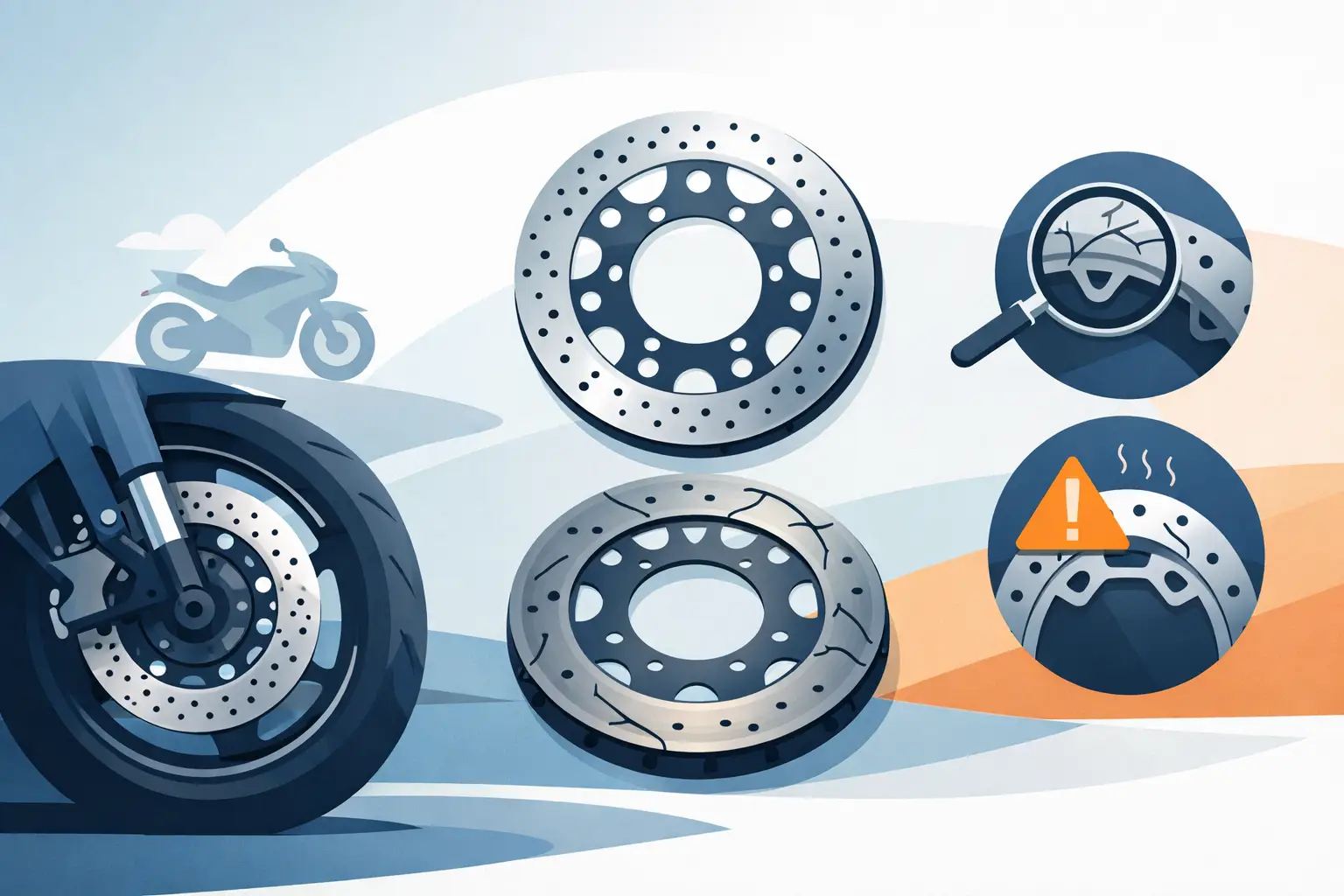
A brake lever that suddenly feels long at the end of a straight is not the time to wonder whether your discs are still serviceable. Knowing when to replace motorcycle rotors is part of proper race-bike preparation, not a guess based on mileage or appearance. Rotors work under extreme heat, repeated load, and constant friction. On a hard-ridden sport bike, they deserve the same attention as pads, fluid, and tires.
Mileage can provide context, but it cannot set the replacement interval. A rotor on a commuter street bike may last many thousands of miles longer than the same rotor used for track days, club racing, or aggressive canyon riding. Brake pad compound, rider braking style, caliper condition, wheel setup, and heat cycles all influence rotor life.
When to Replace Motorcycle Rotors
Replace a motorcycle rotor when it has reached or fallen below its manufacturer-specified minimum thickness, is warped beyond the permitted runout, has cracks or structural damage, or produces braking behavior that cannot be corrected by servicing the rest of the system. Those are the decisions that matter. Surface color alone is not enough.
Every quality rotor has a minimum thickness specification. It may be stamped directly on the carrier or braking band, listed in the service manual, or provided by the rotor manufacturer. Measure the disc with a proper micrometer, not a tape measure and not a visual estimate. Check several points around the braking track, including the area where pad contact is highest.
Use the thinnest valid measurement as your reference. If the rotor is at minimum thickness, replace it. Do not plan to get one more event out of it. A disc that is too thin has less thermal mass, heats faster, can distort more easily, and may compromise braking consistency under repeated hard stops.
Minimum Thickness Is a Hard Limit
Rotor wear is not always perfectly even. The outer edge can look healthy while the active braking band has worn close to its limit. Grooves, pad deposits, and uneven material transfer can also hide the true condition of the disc.
A track rider should measure rotor thickness before a major event and anytime pads are changed. This is especially useful with aggressive sintered or race compounds, which can deliver excellent initial bite and fade resistance while accelerating rotor wear compared with mild street pads. The right pad and rotor combination is about controlled performance, not simply choosing the most aggressive compound available.
If your measurements are close to the limit, replacement is the performance choice. Fresh rotors restore heat capacity and provide a clean surface for bedding new pads. That gives you a more predictable lever, more consistent friction, and greater confidence when braking deep.
Check Rotor Runout Before Calling It Warped
Riders often describe any pulsing lever as a warped rotor. Sometimes that is correct. Often, it is not. Brake judder can come from pad material transfer, contaminated discs, loose rotor buttons on a floating design, wheel-bearing play, incorrect axle installation, a dirty mounting surface, or caliper issues.
Runout is the side-to-side movement of the disc as the wheel turns. Measure it with a dial indicator mounted securely to the fork leg or another fixed point. Consult the motorcycle service manual or rotor manufacturer for the allowed runout specification. If runout exceeds specification, first remove the wheel and inspect the mounting faces. A small amount of trapped corrosion, debris, coating, or damage between the carrier and wheel can create a false runout reading.
Reinstall the wheel using the correct torque sequence and axle procedure, then measure again. If excessive runout remains, the rotor should be replaced. Trying to straighten a modern high-performance motorcycle rotor is rarely a sound solution. Even if it appears to improve, the material may have been stressed by heat or impact and may not remain stable under race-level braking.
Symptoms You Can Feel at the Lever
A rotor problem usually shows itself under braking, but the symptom alone does not identify the cause. A repeated lever pulse that tracks wheel speed can indicate runout or uneven friction material. A vibration through the bars may point to disc variation, although steering-head bearings, fork setup, wheel balance, and tire condition should also be checked.
A lever that goes soft after several hard laps is more commonly related to fluid condition, air in the system, overheating pads, or inadequate cooling than rotor thickness alone. Still, a thin disc contributes because it cannot absorb and shed heat as effectively. Diagnose the complete braking system before buying parts, but do not overlook the discs because they still look shiny.
Cracks, Blueing, Grooves, and Other Damage
Cracks mean replacement. No exceptions for a performance motorcycle. Inspect drilled holes, slot ends, the transition between the braking band and carrier, and the area around mounting hardware. Hairline cracks can begin at stress concentration points after repeated heat cycles. If you find one, retire the rotor.
Blue or purple discoloration is evidence of heat, but it is not an automatic replacement verdict. A rotor that has seen track use will often show color changes. What matters is whether the disc remains within thickness and runout limits and whether it delivers consistent braking without cracking, severe deposits, or distortion.
Deep grooves deserve a closer look. Light, uniform marks are common. Grooves that can catch a fingernail, reduce effective braking surface, or appear with a significant lip at the edge should trigger measurement and inspection. The same applies to heavy scoring caused by worn-through pads. If a backing plate has contacted the rotor, assume replacement is likely until measurements prove otherwise.
Floating rotors need their own inspection. Check the buttons or bobbins for normal movement according to the rotor design. Some movement is expected, while excessive looseness, binding, rattling, or damaged hardware is not. Do not lubricate or modify floating hardware unless the rotor manufacturer specifically instructs you to do so.
Street Miles Versus Track Heat Cycles
There is no universal rotor replacement mileage. A lightly used street machine with clean calipers and quality pads may retain serviceable rotors for a long time. A track bike can consume a set much faster, even when the odometer barely moves.
Heat cycles are the difference. Repeated high-speed braking raises disc temperatures dramatically, then cools them again. Add late braking, heavy rider load, sticky tires, and a fast circuit, and the discs are doing far more work than they would on the street. Riders who have upgraded calipers, master cylinders, or pad compounds may also place greater thermal demand on the rotor package.
This does not mean every performance upgrade shortens rotor life in a harmful way. A properly matched system can improve control and reduce overheating. It does mean the brake system should be treated as a package. Rotor diameter, thickness, carrier design, pad compound, caliper alignment, fluid, and rider use all affect reliability.
Install New Rotors as a System
When replacing rotors, inspect the pads honestly. Installing new discs with heavily worn, glazed, contaminated, or unevenly bedded pads is a poor economy. In many cases, new rotors should be paired with new pads of the correct compound, followed by a controlled bedding-in process.
Clean the wheel mounting faces carefully. Torque rotor bolts to the specified value using the required thread treatment and tightening pattern. Check wheel bearings, axle hardware, caliper bolts, and pad pin condition while the front end is apart. A premium rotor cannot perform as intended if it is installed against a dirty wheel surface or used with dragging caliper pistons.
After installation, bed the pads according to the component manufacturer’s instructions. Avoid immediately holding the bike stationary with hot pads clamped hard against fresh rotors, as this can leave uneven material deposits. Let the system cool between heat cycles when the bedding procedure calls for it.
For track-focused sport bikes, choose rotors by confirmed fitment, intended use, and the rest of the brake package. AXF Race Parts helps riders source race-ready braking components by motorcycle model, making it easier to match premium hardware to the machine rather than forcing a near-fit solution.
The smart time to replace a rotor is before it becomes the weak point in your braking zone. Measure it, inspect it, and replace it on specification. At speed, predictable braking is worth far more than stretching one more weekend from a worn disc.