

Motorcycle Quick Action Throttle Guide for Track

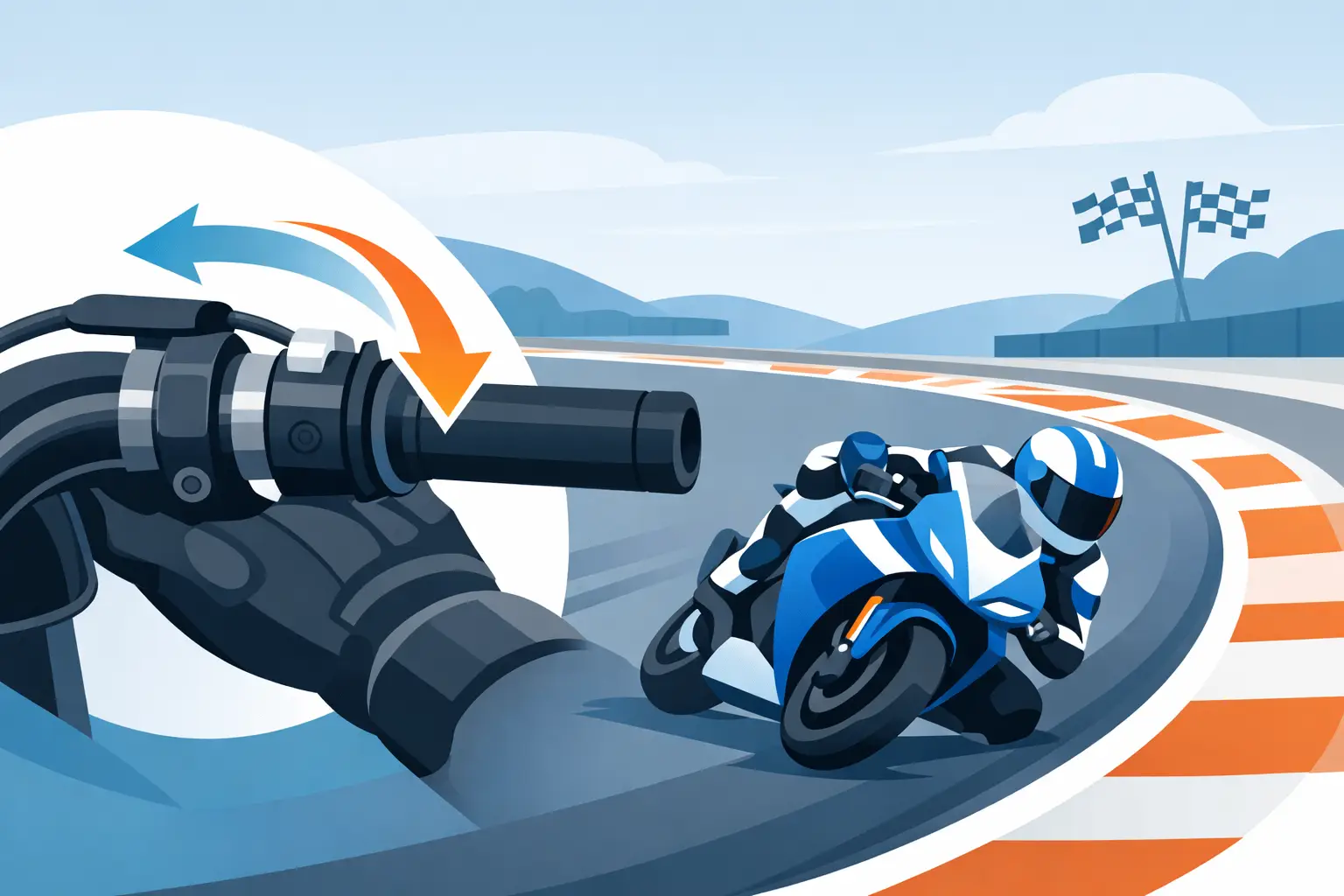
A motorcycle quick action throttle guide starts with one practical question: how much grip rotation do you need to reach full throttle? On a stock sport bike, the answer is often more than a rider wants when exiting a corner, managing a wheelie, or working through a crowded control area with a race glove on. A quick action throttle reduces that rotation, putting full power closer to your natural wrist position.
That sounds like an automatic track upgrade. It is not. A faster throttle can improve control where it matters, but only when the ratio, fitment, cable setup, and rider preference match the motorcycle. Get those details right and the result is a more direct connection between the rider and the engine. Get them wrong and the throttle can feel abrupt, heavy, or difficult to modulate.
What a Motorcycle Quick Action Throttle Changes
A quick action throttle uses a larger cable-pull radius than a standard throttle tube. As the grip turns, the larger radius pulls more throttle cable for each degree of rotation. The throttle bodies or carburetors therefore reach wide-open throttle sooner.
The engine does not gain horsepower. Fuel mapping does not change simply because the throttle tube changes. What changes is the rate at which your hand requests power. A quarter-turn setup may reach full throttle with substantially less wrist movement than an OEM assembly designed to suit a broad mix of street riders.
For a track rider, that shorter rotation can be useful in several situations. On corner exit, you can move from maintenance throttle to acceleration without re-gripping the bar. During a long race or track-day session, less wrist travel can reduce fatigue. It can also make it easier to keep both hands in a strong, balanced position while braking, transitioning, or accelerating over crests.
The trade-off is equally real. Because a smaller wrist movement produces a larger change in throttle opening, low-speed inputs require more discipline. A ratio that feels sharp and efficient on a 1000cc superbike at a fast circuit may feel tiring or overly sensitive on the street, in the paddock, or in wet conditions.
Throttle Ratio Is the Real Decision
Do not buy a quick action throttle based on the phrase “quarter turn” alone. Manufacturers may describe rotation differently, and the installed result depends on the throttle-body pulley ratio, cable routing, and the specific cam fitted to the assembly.
A moderate quick-turn option is often the smart place to start for a track-prepared street bike. It shortens the reach to full throttle without making every partial-throttle adjustment feel compressed. Riders with strong throttle control, race experience, or a bike that requires excessive stock rotation can benefit from a more aggressive cam.
Many premium assemblies use interchangeable cable cams. This is valuable because it lets you tune the mechanical ratio without replacing the whole throttle. A progressive cam can provide a calmer initial opening and a faster pull later in the rotation. A linear cam delivers a consistent cable-pull rate throughout. Neither is universally better. The correct choice depends on engine response, tire grip, electronics calibration, and how the rider uses the bike.
When a Quick Action Throttle Makes Sense
A quick action throttle earns its place when the standard control is limiting your riding position or forcing unnecessary hand movement. It is especially relevant on sport bikes fitted with race clip-ons, aftermarket switch gear, brake master cylinders, data systems, and other components competing for bar space.
On a modern ride-by-wire motorcycle, the decision needs more care. The grip still controls an electronic position sensor rather than a cable, so the available products and installation process differ from a conventional cable throttle. The ECU’s ride modes, throttle maps, traction control, and engine-brake strategies all remain part of the feel. A quick-turn electronic throttle may improve ergonomics, but it will not override a soft rain map or cure poor fueling.
For cable-operated machines, an aftermarket assembly can be a major improvement when OEM hardware is worn, bulky, or incompatible with race controls. It can also make servicing easier, depending on the design. Race-focused throttles are commonly built with alloy housings, replaceable cams, and serviceable internal parts rather than disposable molded components.
A quick action throttle is less compelling if your main complaint is delayed engine response from poor mapping, slack cables, binding throttle bodies, or an electronic throttle map that is too soft. Fix the underlying issue first. Mechanical ratio is not a substitute for proper maintenance or ECU calibration.
Fitment Comes Before Speed
The cleanest-looking throttle assembly is useless if it does not match your bar, cable ends, switch gear, and motorcycle layout. Fitment is where many installations go wrong.
Start with handlebar diameter. Most sport-bike clip-ons use a 7/8-inch, or 22 mm, bar diameter at the grip area, but confirm before ordering. Then identify whether your motorcycle uses one pull cable and one return cable, a push-pull cable arrangement with specific barrel dimensions, or an electronic throttle sensor assembly.
Cable travel matters just as much as cable-end style. The throttle assembly must pull the correct amount of cable to take the engine from closed throttle to wide open without over-travel. Too little pull leaves power on the table. Too much pull can force the mechanism against its stop, create a heavy feel, or prevent the throttle from returning correctly.
Switch gear is another common issue on race builds. OEM switch pods often use locating pins that require holes in the handlebar. Aftermarket racing switches may clamp differently and occupy far less space. Measure the available room between the grip, switch gear, brake master cylinder, lever guard, and steering stop before committing to a throttle housing.
Also consider grip compatibility. Some throttle tubes have a molded or specialized outer surface, while others accept standard race grips. Safety wire provisions, grip length, and the throttle tube’s outer diameter affect both installation and comfort. A grip that slips or bunches at the housing can ruin the precision you bought the throttle to gain.
At AXF Race Parts, fitment-driven shopping is especially useful for this category because sport-bike throttle layouts vary widely by model and year. Verify the product application against the exact motorcycle, then confirm any required cables, cams, grips, or switch assemblies before the build begins.
Installation: Precision Work, Not a Five-Minute Swap
A quick action throttle is a compact part with a major safety role. Installation should be treated accordingly. Remove the existing assembly carefully and inspect both cables for fraying, corrosion, crushed outer sleeves, or stiff movement. Reusing damaged cables with a new throttle is false economy.
Route the cables exactly as intended. Avoid tight bends, pinching behind the steering head, and contact with hot engine components. Once the throttle housing and grips are installed, set cable free play according to the motorcycle or throttle manufacturer’s specification. There must be a small, controlled amount of play at the grip. No free play can hold the throttle open as the bars move or components heat up.
Before starting the engine, turn the bars fully left and fully right while opening and releasing the throttle. It must snap shut cleanly at every steering position. Check that the cables do not tighten, the grip does not rub the bar end or housing, and the steering can reach both stops without interference.
After the engine is running, repeat the steering-lock test while monitoring idle speed. Any increase in rpm with steering movement points to incorrect cable routing or adjustment. Correct it before riding. Then perform a conservative shakedown in a controlled area before relying on the new ratio at track pace.
Setup for Track Use
The first session after installation is for calibration, not lap records. Use the opening laps to learn the new relationship between wrist movement and engine response. Focus on partial-throttle zones: corner entry stabilization, apex maintenance, and the first pickup of drive on exit. Those are the places where an overly aggressive ratio reveals itself.
If the bike has selectable ride modes, begin with the map you know best. Changing the throttle assembly, ECU map, traction-control setting, tire compound, and gearing at once makes it difficult to identify what improved or worsened the bike. Adjust one variable at a time.
A shorter throttle throw can be particularly effective with race gloves, which reduce finger and wrist flexibility. It can also help riders who find themselves re-positioning their hand before full acceleration. But a rider who is already smooth and comfortable with a stock or moderate ratio may gain little from the most aggressive option. Faster input is only useful when it remains accurate input.
For wet sessions or low-grip tracks, a moderate cam or softer electronic map can preserve confidence. The goal is not to make the motorcycle feel dramatic on the stand. The goal is repeatable drive off the corner when tire grip, body position, and race pressure are all demanding attention.
Choose Control Over Hype
A motorcycle quick action throttle is one of the most direct rider-interface upgrades available for a sport bike. It can reduce unnecessary wrist movement, clear up a crowded cockpit, and give a race-prepared machine a more purposeful control feel. It also demands proper fitment and honest setup choices.
Choose the ratio that lets you apply power cleanly at the apex and confidently through corner exit. When the throttle disappears into your technique instead of demanding attention, the setup is working.