
Quickshifter Versus Auto Blipper Explained

A quickshifter versus auto blipper comparison is often framed as a choice between two competing upgrades. In reality, they handle different halves of the shift sequence. A quickshifter manages clutchless upshifts. An auto blipper manages clutchless downshifts. For track riders and racers, the right setup depends on your bike, ECU strategy, riding style, and how much control you want entering a corner.
The terminology causes most of the confusion. Some riders use “quickshifter” to describe any electronic clutchless-shift system, including a factory bidirectional system. Technically, an up-only quickshifter and an auto blipper are separate functions. Buy the wrong component or assume compatibility without checking fitment, and a promising electronics upgrade can become an expensive installation problem.
Quickshifter Versus Auto Blipper: The Core Difference
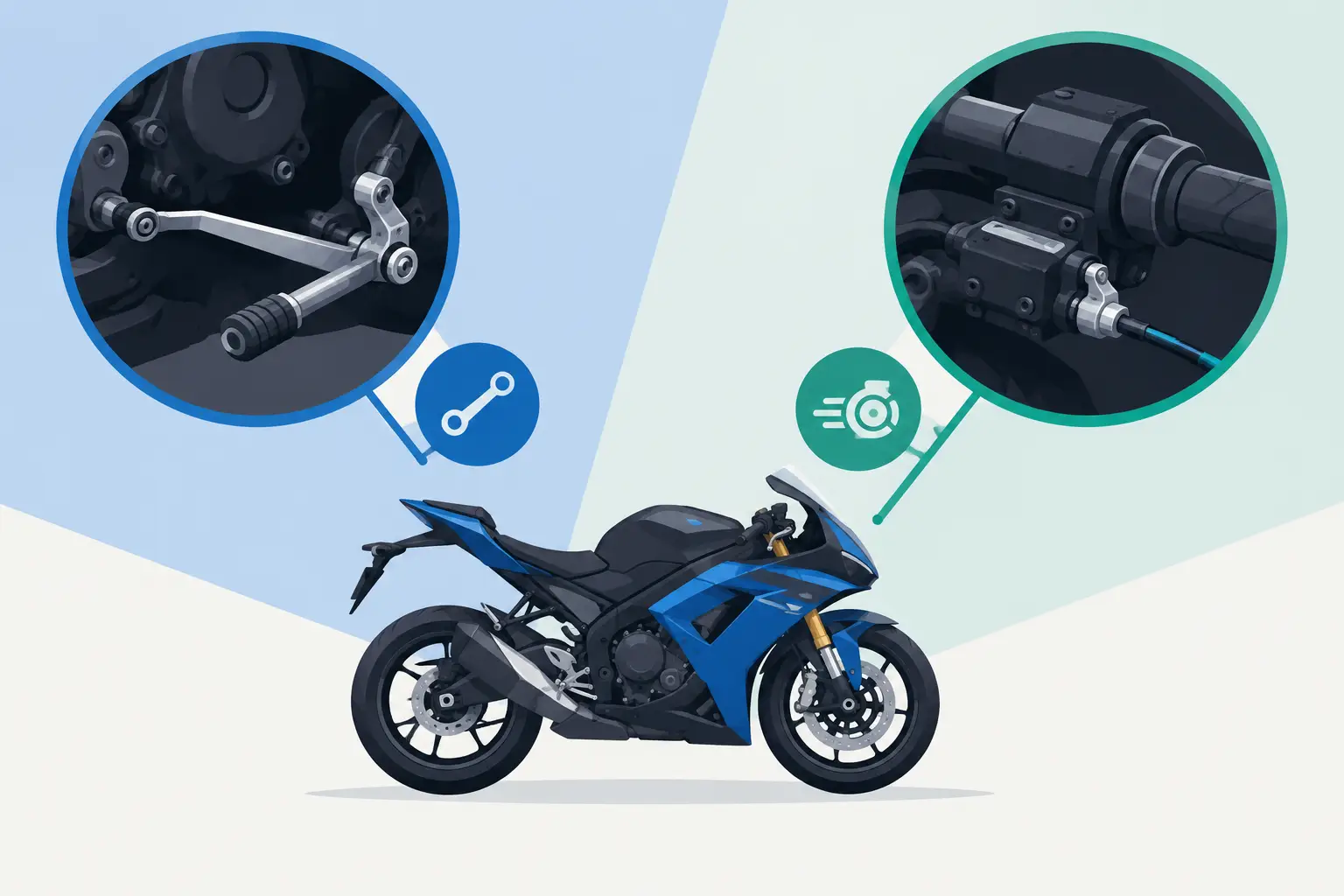
An up-only quickshifter lets you shift to a higher gear without rolling off the throttle or pulling the clutch lever. A sensor on the shift rod detects pressure from your foot. The ECU, or a dedicated control module, briefly interrupts ignition, fuel, or both. That momentary torque cut unloads the transmission dogs so the next gear can engage cleanly.
The result is a faster upshift with less disruption to acceleration. On a straight, that means the bike keeps driving rather than losing time while you close the throttle, pull the clutch, select the next gear, and reopen the throttle. It also reduces the rider workload when the pace rises.
An auto blipper works on downshifts. When the rider presses the shift lever down, the system commands a calculated throttle blip while managing engine torque. This raises engine speed to match the lower gear, allowing a clutchless downshift with reduced rear-wheel disturbance. A properly calibrated blipper makes rapid downshifts more controlled under braking, especially when you are moving through several gears before turn-in.
A bidirectional quickshifter combines both functions. You will often see this described as a quickshifter with auto-blip, an up/down quickshifter, or a race shift system. The important question is not the label on the product page. It is whether the system supports both ignition-cut upshifts and electronically controlled throttle blips for your exact motorcycle.
What You Feel on Track
The biggest gain from an up-only quickshifter appears on corner exits and long acceleration zones. You can stay committed to the throttle through each upshift, keep your body position stable, and avoid a small interruption in drive. On a high-output sport bike, that consistency matters as much as the fraction of a second saved.
The auto blipper changes the braking zone. Instead of coordinating front brake pressure, throttle blips, clutch input, and multiple downshifts at the same time, you can focus more attention on braking force, line selection, and release timing. The system does not replace skill, but it removes a task at the moment the rider is busiest.
That distinction makes the buying decision clearer. If your priority is faster acceleration and you already rev-match well, an up-only quickshifter may be all you need. If you are building a serious track or race bike and want cleaner, repeatable downshifts under hard braking, a bidirectional system earns its value quickly.
Neither system should be viewed as a substitute for a slipper clutch. A slipper clutch manages excessive back torque from the rear wheel during aggressive deceleration. An auto blipper helps match engine speed to the selected gear. Together, they can produce a calmer chassis on corner entry, but they solve different mechanical problems. Many race-prepared motorcycles benefit from both.
Hardware and ECU Requirements Matter
An up-only quickshifter is generally the simpler installation. It needs a compatible shift sensor, correct shift-rod arrangement, wiring or a plug-and-play harness, and a method to interrupt engine torque. Depending on the motorcycle, that may be handled through the stock ECU, an aftermarket ECU, or a standalone quickshifter module.
An auto blipper adds another requirement: the motorcycle must have a way to command throttle opening electronically. On modern ride-by-wire sport bikes, the ECU can often control the throttle plates when supported by the correct software or module. On cable-throttle motorcycles, adding a true electronic blip function is far more complicated and may not be practical without significant race electronics conversion.
This is why model-year fitment is not a minor detail. A system designed for a 2023 ride-by-wire superbike may not work on an earlier version of the same model. Differences in ECU calibration, throttle hardware, connector type, shift pattern, and rearset geometry all affect compatibility.
Aftermarket rearsets deserve special attention. Adjustable rearsets often change shift-rod length and lever position. Some setups require a push sensor, while others require a pull sensor. Standard-pattern and reverse-pattern shift arrangements can also change the sensor direction needed. Confirm the sensor type and mounting configuration before ordering, not after the bike is on the stand.
Calibration Separates Smooth From Harsh
A quickshifter that cuts torque for too long can feel slow and abrupt. One with too little cut time may produce missed shifts or unnecessary gearbox load. Auto-blip tuning carries the same sensitivity. Too little blip can make downshifts feel resistant; too much can create a noticeable surge or unsettle the chassis.
The correct settings vary with engine speed, throttle position, gear, final-drive gearing, and rider technique. A twin, inline-four, and V4 do not respond the same way. A bike fitted with a race exhaust, ECU flash, altered gearing, or engine modifications may need settings different from stock.
For that reason, a quality system with dependable sensor input and appropriate tuning access matters more than chasing the lowest price. Race-grade electronics are designed to deliver repeatable shift events under vibration, high load, and sustained heat. That reliability is what allows the rider to trust the bike at the end of a straight.
Is an Auto Blipper Worth the Extra Cost?
For a street rider who occasionally rides fast roads, an up-only quickshifter can deliver most of the fun and practical benefit. Upshifts become sharper, acceleration feels more direct, and installation is usually less involved. If the bike is primarily used for commuting or casual weekend riding, an auto blipper may be a luxury rather than a priority.
For frequent track-day riders, the value shifts. Repeated heavy braking zones expose inconsistencies in manual rev matching, particularly late in a session when fatigue builds. An auto blipper can help preserve concentration and create more consistent corner entries. It is especially useful on motorcycles with high engine braking or close-ratio gearboxes that require multiple quick downshifts.
For club racers and dedicated race teams, a bidirectional system is often a sensible performance investment when rules permit it. Consistency wins time over a race distance. Clean shifts reduce rider workload, help maintain chassis stability, and allow more attention to braking markers, tire condition, and racecraft.
There are trade-offs. More capability means more wiring, more setup variables, and more potential integration issues if the bike uses mixed OEM and aftermarket electronics. A poorly configured auto blipper is worse than no blipper at all. The system must be matched to the ECU, throttle system, rearsets, and intended shift pattern.
Choosing the Right Shift System
Start with the motorcycle, not the feature list. Verify whether your bike has ride-by-wire throttle, whether its stock ECU supports quickshifter and blipper functions, and whether an aftermarket ECU or control module is required. Then confirm the exact model year, connector style, rearset arrangement, and shift pattern.
Next, be honest about the bike’s job. An up-only quickshifter is a focused upgrade for riders who want stronger drive out of corners. A bidirectional setup is the complete track tool for riders who want faster, more controlled shifting in both directions. If you are already upgrading rearsets, ECU calibration, a slipper clutch, or race controls, plan the electronics package as one system rather than buying parts in isolation.
AXF Race Parts supports performance riders with fitment-specific race components because the details matter at speed. Select the shift system that fits your motorcycle and your program, then give it the installation and calibration attention it deserves. The best shift is the one you stop thinking about because the bike delivers it exactly when you ask.