

Motorcycle Sprocket Sizing Guide for Track Riders

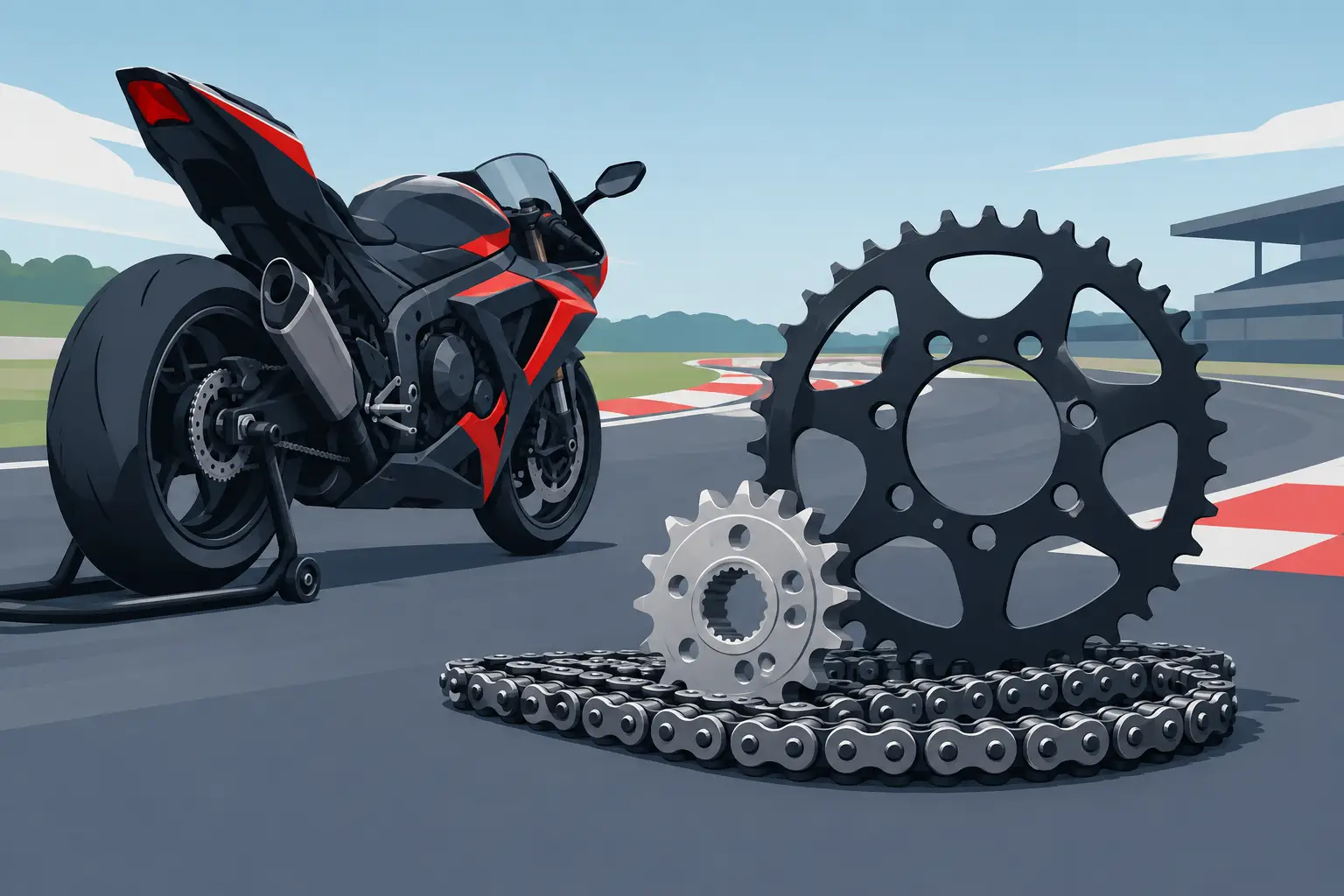
A motorcycle sprocket sizing guide starts with one question that matters on every straight: are you using the engine where it makes power? If your bike falls flat after a slow corner, hits the limiter too early, or spends too much time below its strongest RPM range, final-drive gearing deserves attention. A sprocket change is one of the most direct, cost-effective adjustments available to a track rider – but only when it is matched to the circuit, tire size, engine character, and riding objective.
What Motorcycle Sprocket Size Changes Actually Do
Your front, or countershaft, sprocket and rear sprocket determine the final-drive ratio. Divide the rear sprocket tooth count by the front sprocket tooth count to find it:
`Rear sprocket teeth ÷ front sprocket teeth = final-drive ratio`
A 45-tooth rear sprocket with a 15-tooth front produces a 3.00 ratio. A 48-tooth rear with the same 15-tooth front produces a 3.20 ratio. The larger numerical ratio is shorter gearing.
Shorter gearing multiplies torque at the rear wheel more aggressively. The motorcycle accelerates harder, reaches a given RPM sooner, and feels more responsive when you pick up the throttle. The trade-off is lower top speed in each gear, higher cruising RPM, and a greater chance of reaching the rev limiter before the braking zone.
Taller gearing does the opposite. A smaller numerical ratio reduces engine RPM for a given road speed, extends each gear, and can add usable top speed when the bike has enough power to pull it. It may also calm an overly aggressive first or second gear. The trade-off is softer acceleration and a greater risk of dropping below the strongest part of the powerband after a corner or upshift.
For a race-prepared sport bike, gearing is not about chasing the biggest top-speed number. It is about keeping the engine in the most productive RPM range and making the bike easier to drive from corner exit to braking marker.
Motorcycle Sprocket Sizing Guide: Front vs. Rear Changes
Both sprockets change the ratio, but they do not change it in the same practical way. Rear sprocket adjustments are typically the preferred tuning method because they allow smaller, more precise steps. Adding or subtracting one tooth at the rear makes a noticeable but manageable change, which is ideal when dialing in a known circuit.
Changing the front sprocket creates a larger step. On many sport bikes, dropping one tooth on the front is roughly comparable to adding two-and-a-half to three teeth at the rear. The exact result depends on the original tooth counts. A front sprocket change is useful when the available rear sprocket range cannot reach the ratio you need, but it should not be treated as a one-for-one swap.
Front sprocket size also affects chain wrap and chain articulation. A very small countershaft sprocket forces the chain through a tighter bend, which can increase wear and reduce smoothness. It may be appropriate for a dedicated application, but it is not automatically the best answer simply because it delivers harder acceleration.
For most track riders, start with the stock front sprocket and tune with rear sprockets. Keep front changes for a larger gearing reset, a specific track requirement, or a setup that has been verified for clearance and chain length.
Read the Track Before You Choose a Ratio
The correct gearing is circuit-specific. A tight, technical track with repeated second-gear exits often benefits from shorter gearing. A fast circuit with a long straight may need taller gearing, especially if the motorcycle reaches redline well before the braking point.
Use the longest straight as your first reference. Ideally, the bike should approach peak RPM near the end of the straight in the gear you intend to use, without sitting on the limiter for an extended distance. Do not make the common mistake of gearing solely for that straight, though. If taller gearing leaves the engine lazy through three critical exits, the lap-time loss may be greater than any gain at top speed.
Pay close attention to corner exit. If the engine is below the useful torque range after you pick up the throttle, shorter gearing can make the bike drive harder and reduce the need to abuse the clutch. If the rear tire spins excessively or the motorcycle becomes too abrupt at initial throttle, taller gearing may give you a broader, more controllable delivery.
Gear selection matters as much as the ratio itself. A setup that eliminates an awkward mid-corner shift can be faster and more consistent even if it gives up a few mph at the end of the straight. On high-power machines, a ratio that lets you hold one gear through a fast, loaded corner can also improve chassis stability.
Start With a Baseline, Then Make One Change
Do not arrive at a track day with an untested gearing guess and replace both sprockets at once. Record the current front and rear tooth counts, chain length, tire size, track, ambient conditions, and the RPM or speed reached at the end of the main straight. That baseline gives every later adjustment meaning.
If the engine hits the limiter early, reduce the rear sprocket by one or two teeth, or consider adding a tooth to the front if a larger correction is needed. If the bike never reaches the upper powerband in top gear and feels soft leaving slow corners, add teeth at the rear.
Make one change at a time, then evaluate it over several clean laps. A single rear-tooth adjustment is often enough to reveal whether you are moving in the right direction. Changing gearing, tire pressure, suspension, and electronics together creates noise in the data. You may feel a difference, but you will not know what produced it.
Riders using lap timers or data systems should compare more than maximum speed. Look at RPM at corner exit, time spent at full throttle, shift locations, and acceleration between defined points. Faster is not always the setup with the highest terminal speed. The better setup is usually the one that lets you open the throttle earlier and carry productive RPM through the lap.
Fitment Checks That Prevent Expensive Mistakes
A sprocket ratio can be correct on paper and still be wrong for the motorcycle if the components do not fit. Confirm the chain pitch, front sprocket spline profile, rear carrier pattern, offset, and intended model-year application before ordering. Race bikes can also have non-stock wheels, carriers, swingarms, and conversion kits, so never assume an OEM configuration.
Chain length is the next consideration. A larger rear sprocket pulls the axle forward; a smaller rear moves it rearward. If your axle is already near either end of its adjustment range, a gearing change may require a different chain length. Chain length also affects wheelbase, which can influence traction, turning behavior, and stability under acceleration.
Check physical clearance carefully. On some motorcycles, a substantially larger rear sprocket can approach the chain guide, swingarm, or rear hugger. At the front, verify clearance around the sprocket cover and case saver. Inspect chain alignment after installation, torque fasteners to the manufacturer specification, and set chain slack at the correct suspension position.
If the motorcycle uses wheel-speed-based traction control, ABS, or a speedometer driven from the transmission, a gearing change can affect displayed speed or electronic behavior. Modern systems vary by manufacturer and model. Review the service information and any race ECU or calibration requirements before assuming the electronics will compensate automatically.
Build a Useful Trackside Sprocket Range
A practical race setup is not one perfect sprocket. It is a working range around your baseline. For a dedicated track machine, carrying several rear sprockets in consecutive tooth counts gives you the flexibility to respond to a new circuit, stronger wind, a change in tire profile, or a revised engine tune.
The exact range depends on the bike and your usual tracks, but consecutive rear sizes are more useful than random, widely spaced options. A rider who runs a 15/45 baseline may benefit more from having 43, 44, 45, 46, and 47-tooth rear options than from owning only a 42 and a 50. That spread supports controlled testing instead of drastic guesses.
Use quality sprockets and a chain designed for the load. Lightweight race components can reduce rotating mass, but durability, accurate machining, and correct fitment remain the priority. A worn chain and hooked sprocket teeth can create inconsistent drive, accelerate wear, and make valid gearing evaluation impossible. Replace drivetrain components as a matched set when wear calls for it.
AXF Race Parts supports performance riders with fitment-focused drivetrain options for race-ready sport bikes, helping keep the parts search as precise as the setup work.
Choose Gearing That Lets You Ride Harder
The right ratio should make the motorcycle feel purposeful, not merely aggressive. It should put the engine in the power where you need it, reduce unnecessary shifts, and give you usable drive without forcing the rear tire or electronics to manage an avoidable torque hit. Start with measured changes, verify fitment, and let repeatable lap data guide the final tooth count. The best gearing choice is the one that gives you confidence to release the brake, pick up the throttle, and commit earlier every lap.